
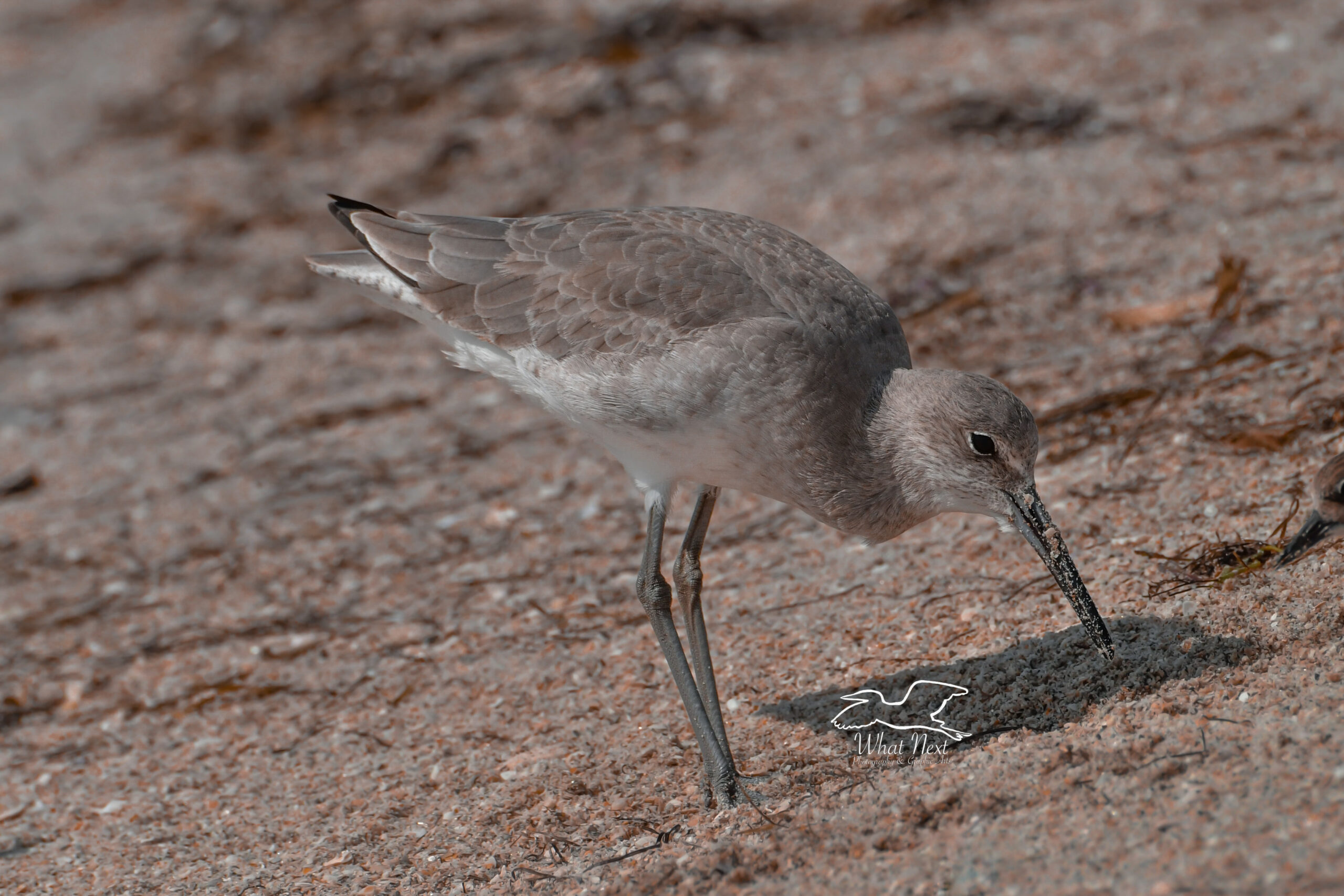
Willets are Interesting Florida Residents

On my last couple of beach visits, one of the most common wading birds I saw were willets (Tringa semipalmata). Some willets live in Florida all year round, but many migrate through or over winter with us, so this time of year there are more willets around than in the summer. Willets are a species of sandpiper and they are divided into two subspecies. Here in Florida we have the eastern subspecies ( T. s. semipalmata) which tends to be larger and has more brown than the western subspecies.

Willets have a mixed diet which consists mainly of aquatic insects, small fish, crabs, mollusks, and worms. They will also sometimes eat plant material. They find food by walking along the beaches or mud flats and watching for movement. They will also probe into the sand with their long, straight, very sensitive beaks. Finally, they will wade into the shallow water where they will catch small fish and aquatic insects. They don’t generally go into any water that is deeper than chest level, but they are competent swimmers if necessary.

Willets can usually be found on ocean beaches, salt marshes, or mud flats. Most of the eastern birds nest in Newfoundland and New England and winter in Florida, Central America, and northern South America. Some also winter in the Caribbean which is unusual for a sandpiper. Willets tend to be shy and easily alarmed, especially when protecting their nests. Nests are usually a scratch in the sand that is lined with pebbles and grass. They are often located in the vegetation edge where it meets the beach. Males and females share incubation chores, but the males take care of the precocial young after they hatch. These birds usually produce one clutch of 3-4 young each year.

These birds were all seen at Fort DeSoto State Park in St. Petersburg, Florida, but I did also see quite a few willets at Fort Island Gulf Beach a couple of weeks ago. All of these birds are in their nonbreeding plumage. When breeding season comes along they become spotted and blotched with brown and white. The willets at Fort DeSoto were pretty used to being around people and were not as shy as most, so it was quite enjoyable to walk along the beach with them or sit and watch them come and go with very little interest in me. I will always like a good walk on the beach, but if I can share it with some interesting birds, it’s even better.


Recent Comments