
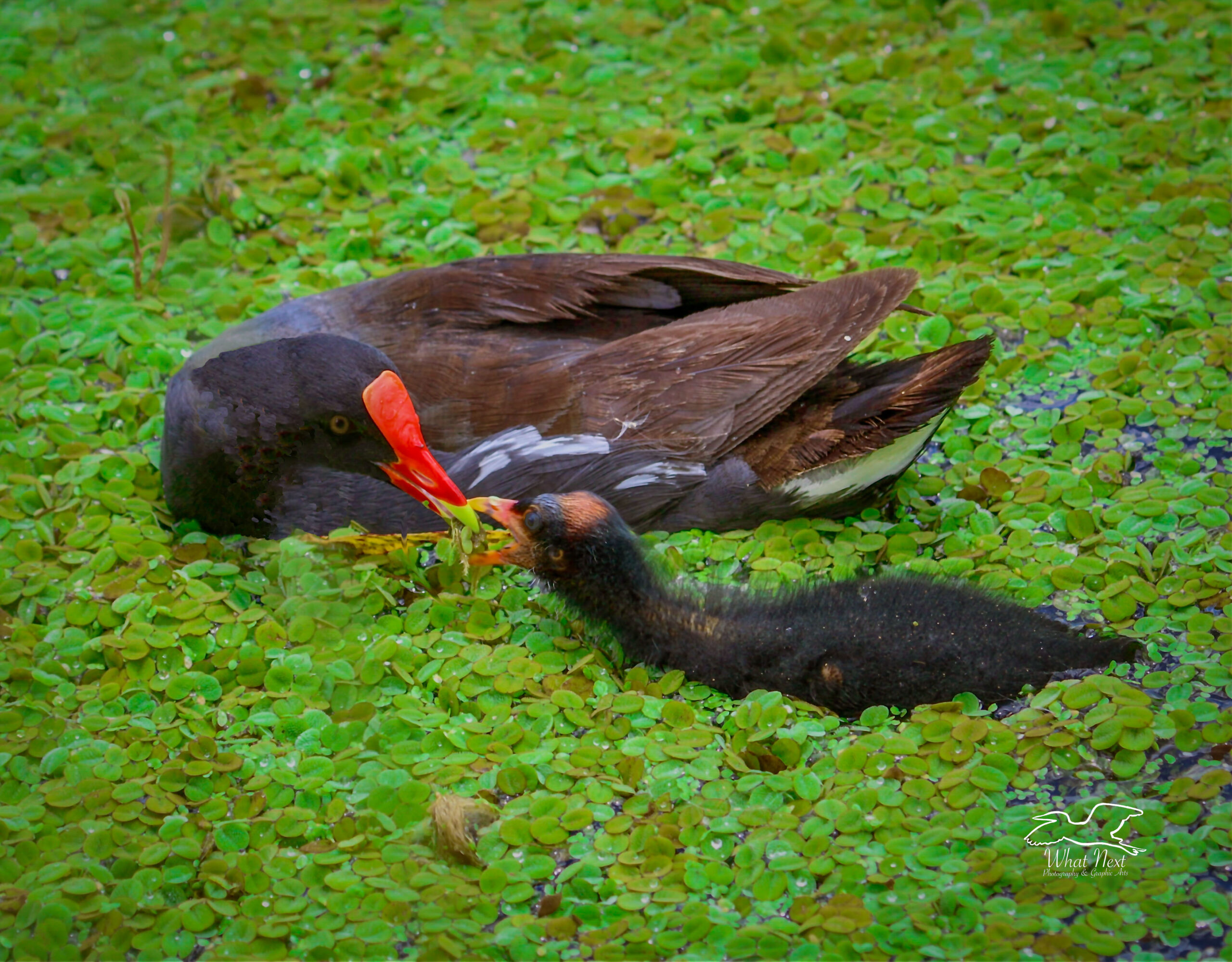
Common Gallinules are Colorful Birds with Interesting Chicks

Earlier in the week, I made a trip out to Sweetwater Wetland Preserve for some late summer birding. I hadn’t been there since this past spring, so I knew there would be something interesting to see. I wasn’t at all disappointed and saw quite a few birds, wildflowers, dragonflies, and butterflies. Although we had seen common gallinules (Gallinula galeata) back in the spring, at that point they were hanging out with the American coots and grebes in good numbers. Now they were mostly roaming around as singles or pairs, and some of them had nestlings with them. The nestlings were definitely not newly hatched, but they were still begging for food (even though they were quite able to feed themselves) and sticking very close to their parents.
Common gallinules are members of the rail family and usually inhabit marshes or swampy areas in either fresh or brackish waters. They like spots with plenty of vegetation both on the water and surrounding it. They can be found throughout much of North and South America, the Carribean, and Hawaii where ever there is water and vegetation. They are closely related to the moorhens of Europe and Asia. Gallinules are true omnivores and eat aquatic plants, seeds, insects, spiders, and snails. They tend to be social, often forming flocks with other types of water fowl except during the breeding season, when they are usually found as single pairs or small family groups. Males and females work together to build the nest, incubate the eggs, and rear the young. Gallinule chicks leave the nest within a few days of hatching, and stay close to their parents. Although the chicks can’t yet fly, they are very capable at both swimming and at climbing around on floating vegetation. Gallinules are well known for their disproportionately log toes and large feet that allow them to walk across mats of floating vegetation or lily pads. Our Florida gallinules are resident birds, but those from areas where the water freezes migrate to warmer regions for the winter. With their striking red beaks and blue grey bodies, they are very attractive adult birds. The chicks, on the other hand, are pretty much so ugly that they’re cute, and watching them interact with their parents and the environment is absolutely fascinating.


Recent Comments